
Sitting for Nothing
An Essay on Zazen

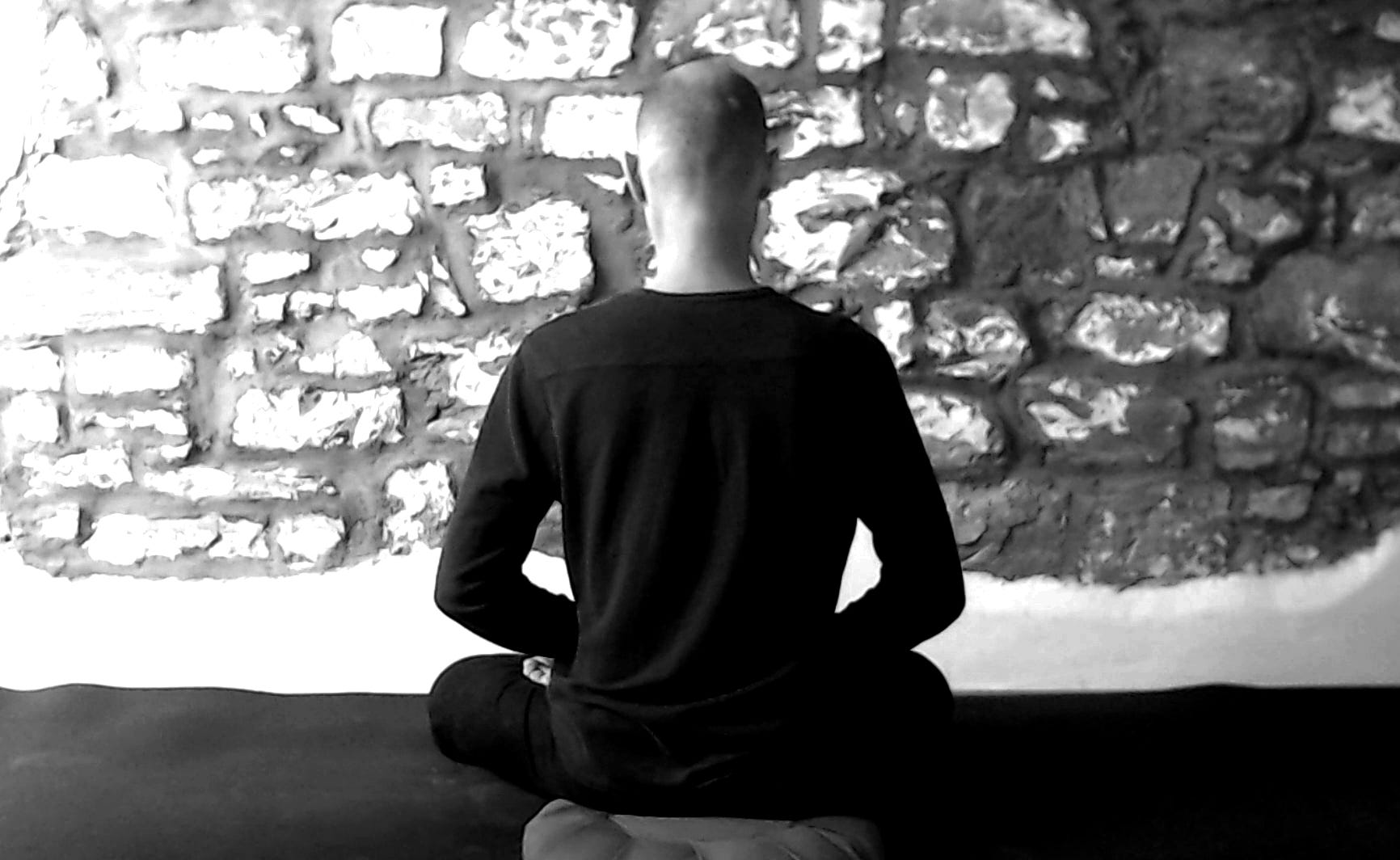
Sitting for Nothing
An Essay on Zazen
“All the Buddhas of the three worlds do not know that there is. Only the cats and oxen know that there is.”
– Nansen (Nanquan Puyuan, 748-834)
Just Sitting
Kodo Sawaki Roshi (1880-1965) was one of the most influential Zen teachers of the Soto school, both in modern Japan and in countries where people practice the way of Zen. Students and followers called him “homeless Kodo,” because unlike other teachers in the Zen tradition, he had no temple of his own and spent his entire life wandering, teaching the practice of zazen. Sawaki Roshi was known for his provocative statements that shattered his students’ romantic notions about Zen. For example, he would say: “Zazen is good for nothing,” or “Zazen is not needed for anything”— not for enlightenment, not for kensho or satori, not to become a Buddha, and not even to calm down and arrive at a more peaceful state. We just sit, and that’s all. This statement by a respected Zen master may seem strange: why practice at all if we achieve nothing through this practice? Yet this is the essence of the paradoxical approach of the Soto Zen school.
The Game of Attainment and Avoidance
Our entire life — the life of people and other living beings — is built on two fundamental impulses: attainment and avoidance. We reach for the pleasant and flee from the unpleasant. We strive to obtain, achieve, grasp, hold, accumulate; and simultaneously to turn away, avoid, push away, protect ourselves. The survival of living beings is built on this endless game. Buddhist teaching describes this game, driven by craving and aversion, as the root of all our suffering. And although we all play it from morning to evening, it seems that the human game differs from the game of other living beings.
A cat hunts when hungry and sleeps when full. A bird builds a nest, raises chicks, and its care ends there. A deer runs from a wolf, but when danger passes, it calmly grazes again. Animals play the game of attainment and avoidance directly, in the present moment. They don’t keep score of yesterday’s victories, don’t accumulate merits, don’t plan tomorrow’s achievements, and don’t compare themselves to other deer, swallows, or cats.
Humans, however, have complicated this game to the extreme. We have turned the direct experience of life into a system of calculations and measurements. On one hand, this has added many additional possibilities for controlling our reality, and consequently, for more successful survival. On the other hand, it has greatly impoverished our life and made us more unhappy. Many actions in daily life — even the simplest ones: eating, communicating with other people, perceiving beauty — we tend to turn into a sphere of accumulating points in the survival game.
Something strange happens here: we have replaced quality with quantity. What is given to us as direct experience — the taste of food, the warmth of touch, the beauty of a sunset — we have learned to describe through numbers, ratings, and comparisons. And gradually, for many of us, the description of experience has not only become more important than the experience itself, but has seemingly replaced the direct experience of life.
Acting this way, we don’t simply live, but constantly and everywhere keep score. At work, in relationships, on social media, and even in spiritual practice: “I’ve been meditating for three years,” “I’ve had five satoris,” “I belong to such-and-such lineage of transmission from true masters of the teaching,” “My level of realization is such-and-such”... We accumulate, accumulate, accumulate, and chase, chase, chase after the next achievements in any sphere of life, taking selfies and displaying ourselves in the shop window of social media: me and the sunset in Bali, me and my beautiful body at the fitness center, and here we are on a yoga mat, me and my book, me and my YouTube channel with ten thousand subscribers, and this is me and my great Guru, this is me on retreat, me at the monastery, me and monks, me and a bowl of soup, me-me-me-me, mine-mine-mine...
Remarkably, this game of scorekeeping is so universal that many of us manage to count the points of our unhappiness as well, again necessarily displaying them for all to see: me and my vulnerability, me and my traumas, me and my failures, me and my depression, me and my narcissism, me and my three hundred hours of psychotherapy with which I still haven’t overcome my rejection trauma, I’ve been meditating for ten years but still haven’t progressed to the level of the fifth jhana, I’ve been through so many retreats, but..., I’ve attended so many satsangs with famous teachers, but... me-me-me-me, mine-mine-mine...
Me and my successes, as well as me and my failures, are essentially no different if I don’t experience life qualitatively, but only accumulate and measure quantities of successes and failures.
This vanity fair, of course, didn’t just open now. Thackeray wrote his immortal work in the 19th century. Gautama Buddha spoke about how this constant scoring of “me and mine” lies at the root of all our suffering two and a half thousand years ago. However, in these times of social media, this human tendency toward selfie-ing has taken on quite caricatured forms.
The Human Meta-Game
Humans have created a meta-game — a game about the game. We humans play not simply for survival, but play for meanings, for identity, for proof that our life is worth something, that we fundamentally have the right to exist. We play even when all basic needs are satisfied. When the refrigerator is full, there’s a roof over our head, security is ensured—we continue to chase. After what? After the next level in the game. After recognition. After approval. After prestige. After a sense of our own rightness. After the feeling that we’re moving somewhere, achieving something, becoming someone.
And most importantly — having gotten carried away, we forget that it’s a game. We take the score for reality. Numbers in a bank account, positions, ranks and titles, the number of followers on social media, spiritual achievements — all this can become absolutely real and important to us. And if so, then losing in such a serious game turns into a catastrophe, and winning — into salvation. Any stop or even pause can also automatically mean losing, or falling behind, or missing opportunities, and ultimately lead to a loss of the meaning of existence. Because if I can’t measure myself by something, then I don’t exist.
Kodo Sawaki said about this:
“To wander from place to place in this transitory world is to pursue ‘name’. A person is born naked. But then he is given a name, registered, and covered with clothes, and a nipple is stuffed into his mouth, and so on. When he grows up you say, ‘He is great, strong, clever, rich.’ You find consolation only in words.
In fact, everyone is just naked. Rousseau said, ‘Even emperors, nobles and great, wealthy men were born naked and poor, and at the end of their lives they must die naked and poor.’ This is absolutely true. For a short while between birth and death, human beings put on various and complicated clothes. Some wear beautiful costumes, some rags, some prison uniforms. There are the clothes of status and class, of joy and anger, of sadness and comfort, of delusion and enlightenment. We unwittingly take these clothes to be our true selves, and devote ourselves to obtaining, by any means, a satisfactory wardrobe.”
A Break from the Game
Zazen in the Soto tradition is a way to take a break from the endless game. Not to win the game. Not to exit it forever. Not to achieve a state where the game no longer concerns us. No, zazen is simply a break. A pause. Thirty minutes, forty, an hour, a day, or five days, when the score can be temporarily stopped, when we can shift from quantitative measurement of life to qualitative living of it.
We sit on a cushion facing the wall. The wall wants nothing from us. It doesn’t keep score, doesn’t evaluate whether we sit well or badly, whether we’ve progressed in practice or gotten stuck. We breathe. Breath comes and goes — without goal, without achievement, without result. We listen, and hearing simply hears.
Hearing hears, seeing sees, the body feels, the heart beats, breath breathes, thoughts come and go by themselves, attention moves here and there by itself, consciousness is aware. Fire burns, water flows, wind blows, earth provides support. And we, as the fifth element, are simply here, we simply are present. Presence is a qualitative experience; it cannot be measured.
The Space of Presence
What happens in this presence? We return to direct experience. Not to its description, not to its measurement, not to its evaluation, not to its accumulation, but to the experience itself. There is the sensation of breathing. There is the feeling of density of the butt’s contact with the cushion. There is the coolness of air on the skin. There is a sound outside the window. There is the whiteness of the wall before the eyes. All this—not ideas about experience, not thoughts about whether we’re doing it right. This is the very fabric of direct experience, which has always been here, before all our calculations and measurements.
We don’t sit for enlightenment. Not for peace of mind. Not for accumulating spiritual merits. Not so that we can later say: “I practice zazen.” We sit for nothing.
And in this “for nothing,” something mysterious happens. When the game is temporarily suspended, when we stop chasing and accumulating at least for the duration of practice, when we let go of the need to measure and evaluate everything, then space appears. The space of life, not divided into inner and outer. More precisely, inner and outer spaces are still recognized by us as such, but they are both included in the immeasurable space of our presence.
And this experience happens not as an achievement, not as the result of correct technique, but simply as a natural consequence of the fact that we have temporarily stepped out of the race of dividing everything into parts, measuring, appropriating, and accumulating.
This space is not the emptiness of absence, but the fullness of presence. When we stop turning life into a set of measurable indicators, when we temporarily turn off the calculator and simply allow ourselves to be, life returns to its original immediacy. Like a cat that simply hunts when hungry. Like a deer that simply grazes when danger has passed.
Returning to the Game
But, like everything in this world, our formal zazen practice ends sooner or later. The gong sounds. The break from the game of attainment and avoidance ends. We get up from the cushion and return to the game. After all, the game hasn’t gone anywhere — work, relationships, accounts, plans, worries — everything is in its place.
Nevertheless, something in our very attitude toward the game can change. Not radically, not forever, perhaps only slightly, barely noticeably, like a subtle shade of experience. However, perhaps we can now believe a little less in the absolute importance of measuring and accumulating? Perhaps we can now keep score with less seriousness? Perhaps!
Perhaps, after catching a hint of qualitative being during a break from the game, we can relate to quantitative description merely as a description of life, and not as life itself. The number on the scale is a description, but not the experience of the body. The boss’s evaluation is a description, but not the work itself. The number of years of practice is a description, but not the experience of zazen itself. And when we remember this, we can play a bit more playfully, a bit more lightly, a bit more freely.
Like three-year-old children play. For them, a game is simply a game, in which it’s not about winning and losing, but about the game itself. They are fully in the game, but not enslaved by it. They can drop the game at any moment and go do something else, not clinging to the result. They haven’t yet learned to replace experience with its measurement. Haven’t learned to consider themselves alive only if they can be measured by accumulated merits. They simply live.
Zazen returns to us this childlike ability—to play without becoming prisoners of the game. Not once and for all, but by sitting in zazen again and again, reproducing the experience of a break from the game again and again, touching the absolutely unique and unrepeatable experience of life. Zazen, in this way, becomes training in the ability to remember that you can take a break. That the score is not absolute. That behind all our descriptions and measurements, life itself pulsates and breathes—direct, qualitative, immeasurable. That you can just sit—for nothing.
This is exactly what another famous Zen teacher of the twentieth century, Shunryu Suzuki, meant when speaking of “beginner’s mind.” He said: “In the beginner’s mind there are many possibilities, but in the expert’s there are few.” Beginner’s mind is not a mind that says: “I’ve had five satoris, and now I want a sixth,” but a body-mind that sits on the cushion each time as if for the first time, without expectations, without keeping score, without the goal of becoming someone or achieving something. The beginner’s body-mind sits to simply sit.
When I’m Hungry—I Eat. When I’m Tired—I Sleep
Vinaya master Yuan asked Great Pearl, “When you practice the Way, do you use a special skill?”
Great Pearl said, “When I’m hungry I eat. When I get sleepy I sleep.”
Yuan said, “Everyone does these things. Do they not have the same skill as you?”
Great Pearl said, “They do not have the same skill. When they eat it can’t be called eating, since they do so [while involved] with a hundred entanglements. When they sleep it can’t be called sleeping, since their mind is beset with worries. Thus they are not the same.”
The Vinaya master was silent.
– Daoyuan, Records of the Transmission of the Lamp, 1004 CE
The same text in Russian:
Сидеть ни для чего
Collection of all essays:
Just Sitting?
You can join the Cloud Sangha’s shared practice here:
Cloud Garden of the Year
Since February 24, 2022, from the beginning of Russia’s war against Ukraine, I have taken a vow to work for voluntary donations (similar to a Buddhist monk). Since then, at least all of my online activity, which takes up 95% of my working time, has been happening in exactly this format. I intend to maintain this practice until the end of the war, and then we’ll see. If you value the “Buddha in the City” project and want it to live and continue its work, you can support it here in whatever way is convenient for you:
Support Buddha in the City
All the best to you, and see you on the cloud,
Valery Veryaskin