
Liberation from Definition
An Essay on Zazen

Liberation from Definition
An Essay on Zazen
Thus Coming, Thus Going
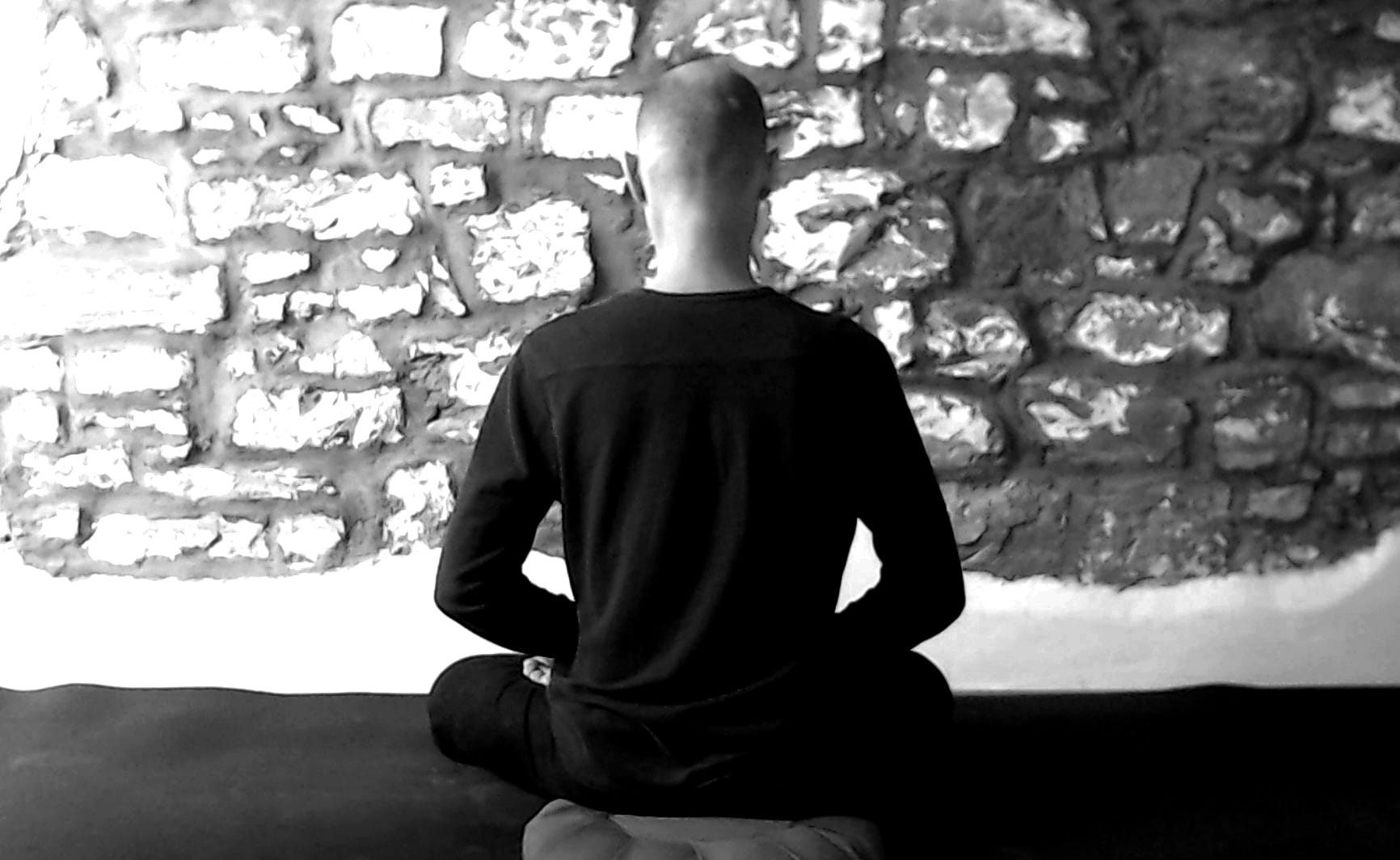
Just before I began writing these lines, I was sitting quietly. Breathing quietly. Listening. The world was coming to me, and I was coming to the world. Moving neither forward nor backward, I sat and listened. But the world was coming to me, and I was coming to the world. The world was entering me, and I was entering the world. With each breath in and out, in moments of seeing, in moments of listening.
When I look — is it I who enter the world with my gaze, or does the world enter my seeing? When I listen — does the world enter my hearing, or do I make my way through it with my listening? The world — thus coming, the world — thus going. I — thus coming, I — thus going. The world and I are both Tathagatas, and one cannot say whether we are two or one.
And now? And now I sit quietly. Breathe quietly. Listen. The world comes to me, I come to the world. Moving neither forward nor backward, I sit, listen, and write. Besides breath, listening, and seeing, the world now comes to me also in the form of words. And I come to the world — in the form of words. The world, I, and words — are these three, or one?
Retreat Time
In our Cloud Sangha, every month we conclude with a one-day silent retreat, and every season with a three-day one. Yesterday was the one-day retreat. Retreat time is favorable for stopping and listening carefully — to oneself and to reality. Discovering that I and reality are not two and not one, that we are two and one.
In the quiet space of the retreat’s stillness, clearer vision often comes to me — of where and why I am going. This time too, sitting zazen and watching as, layer by layer, the veil of everyday worries, anxieties, memories, fantasies, and judgments slips from my eyes, I could more and more clearly discern the infinite space of being stretching before me, and the infinite space of being stretching within me. These spaces are not one and not two; these spaces are two and one.
What could be more precious than this sense of unity with infinite life? What could be more precious than liberation from the fear of the small “I” pushing through the thickets of a vast and dangerous world, where this small “I” feels alone, estranged, abandoned, and lost? What could be more precious than the sense of flowing freely with the current of life as it is? Yes, with its pain and pleasure, with its joy and sorrow, with its gains and losses, with its births and deaths, yes, with all its contradictions and opposites, and yes, with its wholeness that transcends all contradictions and opposites.
When, layer by layer, the veil of everyday worries, anxieties, memories, fantasies, and judgments slips from my eyes, I more and more clearly discern the infinite space of real, non-imaginary life stretching around me and within me — where what I call myself is merely a gate between two infinities. A conditional gate in the midst of absolute reality. A gate through which the world comes to me and I come to the world. Thus coming, thus going.
The Music of Breathing
Recently I came across a quotation from the novel “The Pass of the Great Bodhisattva” by the Japanese writer Nakazato Kaizan:
“Kyorei” is the sound of the heavens themselves; “koku” is the sound of the wind’s breath; and only in “rempo” do we for the first time have to do with the sound of human breathing.
However far one walks, however far one walks on — a person still walks the earthly path. Sad is the sound of footsteps on the journey across the earth: from where they come and where they go, no one knows. Quiet and sorrowful is the autumn wind over the clover-hagi bushes; onward and onward goes the wanderer walking the earth. But then he hears the heavenly music of kyorei and longs to merge with it. Is this not the timbre and melody of rempo?
This speaks of the zen wanderers called komuso, whose two principal spiritual practices — endless wandering along the dusty roads of Japan and playing the flute — are united in a single way of life. But not only they are this way; every human being who has ever lived on earth, each of us, is a wandering komuso. We all wander, passing from age to age, from period to period of our life’s journey, from situation to situation, from event to event, from moment to moment, and our path has neither beginning nor end. Even birth and death are not the beginning of the path and not its end. The longer I walk the roads of life, the more clearly I see this, the more deeply I feel it.
And it is entirely natural that on this endless path every wanderer may experience sorrow, for all one does is leave the places one arrives at. No sooner have you grown accustomed to a certain age than it is time to leave it. No sooner have you settled into some life situation than it is already ending, pushing you into another. And is it not the same with the moments of life?
Each of us, human beings, is a Tathagata — thus coming into a moment of life and in that very same moment thus going from it, for in no moment is it possible to linger. Each of us, human beings, is thus gliding through this world. How could one not feel sorrow, when there is nowhere to lay one’s head?
But the wandering musician, hearing the music of the boundless sky, yearning for that boundlessness, yearning for the journey’s end, yearning for home, raises the flute to his lips, and within it the music of his breathing is born. In the music of rempo’s breathing, the music of the wind koku and the music of the sky kyorei meet and are joined into one. And can one draw a boundary in this music between home and path? For the musician is a gate through which sky and wind enter human breath, and breath returns to sky and wind. Can one distinguish the breath of sky, wind, and human? Can one say that anyone is coming anywhere or that anyone is going, when music sounds?
The Koan of Life
In Cloud Sangha, we have begun reading and studying Dogen’s “Genjokoan” in detail. The very title of this essay conveys its central message.
For Dogen, a koan is not an intellectual puzzle designed to “break” the mind. In the Rinzai school, koans are indeed often used as a way of moving thinking out of its habit of reducing living experience to ready-made definitions, and this works, but Dogen’s emphasis is different. For Dogen, a koan is not an object of reflection, but a way of living; it is a vision and a way of life in accordance with that vision. All of life is a koan, because experience is always larger than any explanation. Paradoxes need not be constructed, for they are already present in reality itself. In each of its moments, life is spacious — and therefore the only thing we need to do is flow into that spaciousness, simultaneously embracing life in its fullness.
Koṇḍañña Who Has Understood
Yesterday, during the retreat, a formulation came to me:
“The essence of Zen practice lies in releasing attachment to defining.”
And although such an understanding has come to me more than once before, and although many Zen practitioners and teachers constantly point to it, still — however many times I recognize it — in a moment of unclouded clarity, what is seen is always experienced for the first time.
Is this not the same vision that opened to Kondanna when he heard the Buddha’s first teaching?
“And while this discourse was being spoken, there arose in the Venerable Kondañña the dust-free, stainless vision of the Dhamma: “Whatever is subject to origination is all subject to cessation.”
Then the Blessed One uttered this inspired utterance: “Koṇḍañña has indeed understood! Koṇḍañña has indeed understood!” In this way the Venerable Koṇḍañña acquired the name “Añña Koṇḍañña—Koṇḍañña Who Has Understood.”
— Dhammacakkappavattana Sutta. (Setting the Wheel of Dhamma in Motion)
Kondanna’s statement was not a banal assertion that “everything in this world is transient.” Nor does it sound like a complex philosophical concept, yet, judging by the Buddha’s vivid response, these words express Kondanna’s deep insight into the nature of reality.
I sense the closeness of my own formulation to Kondanna’s spontaneous exclamation. What “definition” does the Buddha’s path transcend? Not the perception of forms as such, not definitions themselves — for these are necessary — but their solidification: when a symbol substitutes for reality, when meaning hardens into the final word, when form is torn from the countless relationships into which it is woven. This is the urge to turn a moment into a formula, to stop movement, to absolutize the relative.
And this is precisely what I recognize as the power of Kondanna’s phrase: ‘Whatever arises also ceases.’ This is not a thought, but direct seeing. The seeing that any arising experience cannot be fixed as absolute; that any image cannot be an absolute expression of reality; that any state cannot last forever; that any phenomenon cannot exist in isolation from others.
Firewood arises — and ceases, becoming ash. Ash arises — and ceases. The retreat arises — and ceases, becoming memory. Memory arises — and ceases. Even this understanding of mine arises right now — and will cease in the next moment. And yet firewood is fully firewood, ash is fully ash, this moment is fully this moment.
Everything that arises in our perception as a separate form exists only relatively. Relative to me, relative to another, relative to itself a moment ago. The Absolute, however, is in principle inexpressible and ungraspable. The Absolute cannot be an object of perception, for everything exists only within the Absolute.
But if the Absolute is ungraspable, then the relative form is also ungraspable — for its boundaries in time and space are conditional. And so it turns out that clinging to the Absolute is impossible, and clinging to the relative world is also impossible. Yet we cling.
Our reflexive attempts to cling are what contemporary psychology calls a cognitive bias, and traditional Buddhism calls delusion — and although there is no fault of ours in this mistaken perception, this does not relieve us of responsibility toward the attempts at liberation from delusion. Toward the attempts at liberation from defining.
Genjo — Manifesting-Becoming
Dogen names his essay “Genjokoan,” and in this very title there is already a key to understanding how to release attachment to defining.
The word “genjo” (現成) consists of two characters:
現 (gen) — “to appear,” “to be present,” “to actualize” — the coming into visibility of what was potential, like the moon emerging from behind clouds;
成 (jo) — “to become,” “to complete,” “to accomplish.” Together they form a paradoxical concept: being-becoming.
These are not two sequential actions — first becoming, then being — but one non-dual movement of reality, which simultaneously is and becomes.
I am already what I am, right now. Fully. Completely. In relationship with everything that exists in reality. And at the same time I am constantly becoming. Not becoming something other than what I am, but becoming precisely what I already am. In relationship with everything that exists in reality.
Moving neither forward nor backward, I simply am. But the world infinitely comes to me, and I infinitely come to the world. The world enters me, and I enter the world. With each breath in and out, in moments of seeing, in moments of listening. When I look — is it I who enter the world with my gaze, or does the world enter my seeing? When I listen — does the world enter my hearing, or do I make my way through it with my listening? The world — thus coming, the world — thus going. I — thus coming, I — thus going. The world and I are both Tathagatas, and one cannot say whether we are two or one.
“Firewood becomes ash; it can never go back to being firewood. Nevertheless, we should not take the view that ash is its future and firewood is its past. We should recognize that firewood occupies its place in the Universe as firewood, and it has its past moment and its future moment. And although we can say that it has its past and its future, the past moment and the future moment are cut off. Ash exists in its place in the Universe as ash, and it has its past moment and its future moment. This firewood, after becoming ash, does not again become firewood.”
— Dogen, Genjokoan
Firewood fully occupies the place of firewood. Ash fully occupies the place of ash. Each is complete in its own moment — and each is already moving. Firewood and ash are two and one, are not two and not one. This is what genjo means: the fullness of embodiment and the process of embodiment — simultaneously. Completion and becoming — simultaneously. In this contradiction lies the nature of reality.
And in this consists liberation from definition. For defining attempts to say: “Firewood is only firewood, and ash is only ash.” Or: “Firewood will become ash in the future.” But genjo shows: firewood is fully firewood right now — and is already becoming ash. Not two actions, not two moments. One non-dual movement.
Koan — Public Case
The word “koan” (公案, or in Dōgen’s own writing 公按) was originally a legal term — a case before the bench, a public document, a ruling open to all. But Dōgen’s choice of characters tells us something deeper.
公 (kō) — “public,” “open to all” — but in the fuller sense: to equalize inequality, to make fair what is unfair, to bring order to disorder. This is the meaning carried by government officials in ancient China when they sought to resolve disputes between citizens with impartiality and wisdom.
案 (an) — “case,” “document,” “desk” — the common character used for koan in Rinzai practice. But Dōgen himself used a different character: 按, whose root meaning is “to press,” “to push with a hand” — as in massage, which heals the body by restoring it to order. In this broader sense, an means to investigate what has fallen out of order, in order to set it right again.
Together, in the reading of Senne — Dōgen’s direct disciple and personal attendant — kōan means: kō, to equalize inequality; an, to keep one’s lot, to remain in one’s own place. In other words, a koan holds in tension the universal and the particular, the equality of all things and the absolute uniqueness of each being. One hand is fully one hand. Five fingers are fully five fingers. These are not two separate truths — each is absolute, and each contains the other.
The bench is the place where the judge sits in a position of authority, where evidence is presented, and where a verdict is rendered. In the Zen tradition, this metaphor was alive and immediate: the master, like a judge, could see the state of mind of the student with complete clarity. When a monk walked through the gate of the monastery, the master could recognize delusion as plainly as a judge recognizes guilt. “Yours is an obvious case” — this is how the Zen master Mujo addressed a monk arriving to study with him. The case was clear. The delusion was visible.
And this is precisely why the koan is not a private, secret experience of one individual. It is a public document, like a law of the empire — a universal truth accessible to all, like a court ruling that becomes a precedent for everyone. A koan is an established case of the Dharma’s manifestation, open to anyone who can see it. It is not a riddle to be solved, but a case that becomes obvious — the moment the mind stops clinging and defining, the moment it releases its grip on certainty.
“Whatever arises also ceases” — this is a koan.
“Firewood abides in its place in the Universe” — this is a koan.
“The world enters me, I enter the world” — this is a koan.
Life is a koan.
Genjokoan
Now we can understand the full meaning of the title. Genjokoan is the manifesting-becoming of the “obvious case” of truth. It is reality that simultaneously is and becomes, manifesting itself as universal truth in each moment, in each place, in each being.
This is not a philosophical concept. This is what is happening right now.
While I sit in zazen, layer by layer releasing the veil of fixed definition — this is genjokoan. When the wandering komuso raises the flute to his lips and becomes a gate through which sky, wind, and breath meet in one music — this is genjokoan. When Kondanna hears the Buddha’s teaching and the unclouded vision opens to him: “Whatever arises also ceases” — this is genjokoan. When firewood fully occupies the place of firewood — and is already becoming ash; when ash fully occupies the place of ash — and was firewood — this is genjokoan. When I, moving neither forward nor backward, sit — and the world comes to me and I come to the world — this is genjokoan.
In the Airport
I have been writing this essay in snatches over the course of several weeks. The firewood of life that burned during the retreat has long since become ash, and right now I am sitting in Amsterdam Airport, where quite different firewood is burning.
I am sitting in a café. Sitting quietly. Breathing quietly. Listening. Looking. The world comes to me, I come to the world. Moving neither forward nor backward, I sit, listen, and write. People come and go. People speak in different languages. Do people in an airport become people of the earth, and in an airplane people of the sky? Or are they the same people?
People arise in the airport — and cease, boarding the plane. People arise in the plane — and cease, disembarking. Whatever arises also ceases. And yet each person is fully a person in each moment.
Firewood and ash, ash and firewood. People on the ground and people in the air. I on retreat and I a month later — are these the same people or different ones?
When the wandering komuso raises the flute to his lips, music is born in it. Is this the music of breathing? The music of the wind? The music of the sky? Can I be certain?
Dogen advises me to live the genjokoan of life; he advises me to let the music of breathing sound — music that belongs neither to sky, nor to wind, nor to human. Music that belongs to sky, wind, and human.
Bergen
The time in the airport has ended, but my attempts to express the inexpressible continue. I am finishing my essay in the city of Bergen, in Norway. I am sitting quietly again. Breathing quietly. Listening. Looking. The world comes to me, I come to the world. Moving neither forward nor backward, I sit, listen, and write. I am a guest at friends’ home.
All my life I have felt myself a guest in this world, felt myself a wanderer, passing from age to age, from period to period of my life’s journey, from situation to situation, from event to event, from moment to moment — and my path has neither beginning nor end. I have never had and do not have a home of my own, a home I would own — yet it is partly because of this that I feel at home in my endless wandering. I come to stay with friends, I move into a rented apartment or a hotel, and I make that space my own, settle into it, and make myself at home. This teaches me to relate in the same way to the spaces of my different ages — where I need to settle in and make myself at home — and to the spaces of the various situations and events of life.
Tomorrow will be the fourth anniversary of Russia’s full-scale war against Ukraine. This four-year-long period is a space through which my fate passes. The war arose — and will cease. But while it lasts, it is fully here, fully now. And it matters to me to go on being alive within this space; it matters to me that the music of my life should go on sounding. Even if it sounds sad, sorrowful, and tragic — it is still the music of life.
The Music of Zazen
The komuso monks call their flute practice “suizen” — “zen of blowing.” We in Cloud Sangha call our practice “zazen” — “zen of sitting.” When the komuso monk breathes through the flute, it is sky and wind breathing together with him. When we sit motionless in zazen, it is all of reality sitting together with us, all of reality sitting as us.
Moving neither forward nor backward, we sit. And the world comes to us, and we come to the world. The world enters us, and we enter the world. We and the world are both Tathagatas — thus coming, thus going. And one cannot say whether we are two or one.
Gate gate pāragate pārasaṃgate bodhi svāhā
Gone, gone, beyond the beyond,
beyond even the boundless — awakening,
I greet you!
The same text in Russian:
Освобождение от определённости
Collection of all essays:
Just Sitting?
You can join the Cloud Sangha’s shared practice here:
Cloud Garden of the Year
Since February 24, 2022, from the beginning of Russia’s war against Ukraine, I have taken a vow to work for voluntary donations (similar to a Buddhist monk). Since then, at least all of my online activity, which takes up 95% of my working time, has been happening in exactly this format. I intend to maintain this practice until the end of the war, and then we’ll see. If you value the “Buddha in the City” project and want it to live and continue its work, you can support it here in whatever way is convenient for you:
Support Buddha in the City
All the best to you, and see you on the cloud,
Valery Veryaskin